Discovery dossier · Geography, interpretation and ancient connections
Atlas: Canada, Africa and the burden-bearing figure
Why Brett connects a figure in the Great Lakes landscape with the Atlas Mountains and a story that reaches across continents.
← Atlas imagesThe interpretation begins with a supporting figure
Brett reads the Great Lakes landscape as a large, burden-bearing figure: Atlas. In his interpretation, the Canada–Ontario–Toronto region belongs to the figure, while Michigan and the surrounding lake basin form the scene’s supported or held mass. The relationship matters as much as the outline: he sees a figure holding something up, connecting the geography to the familiar Atlas motif.
His own description on May 20, 2026 was direct: “Didn't we log the Titan Atlas already he's in Canada Toronto holding up Michigan”. In the next message he asked, “And it's part of the mountains that broke away into Africa as well right”. These two observations belong together in this dossier: the local figure and the larger continental connection.
Read the landscape in its original direction
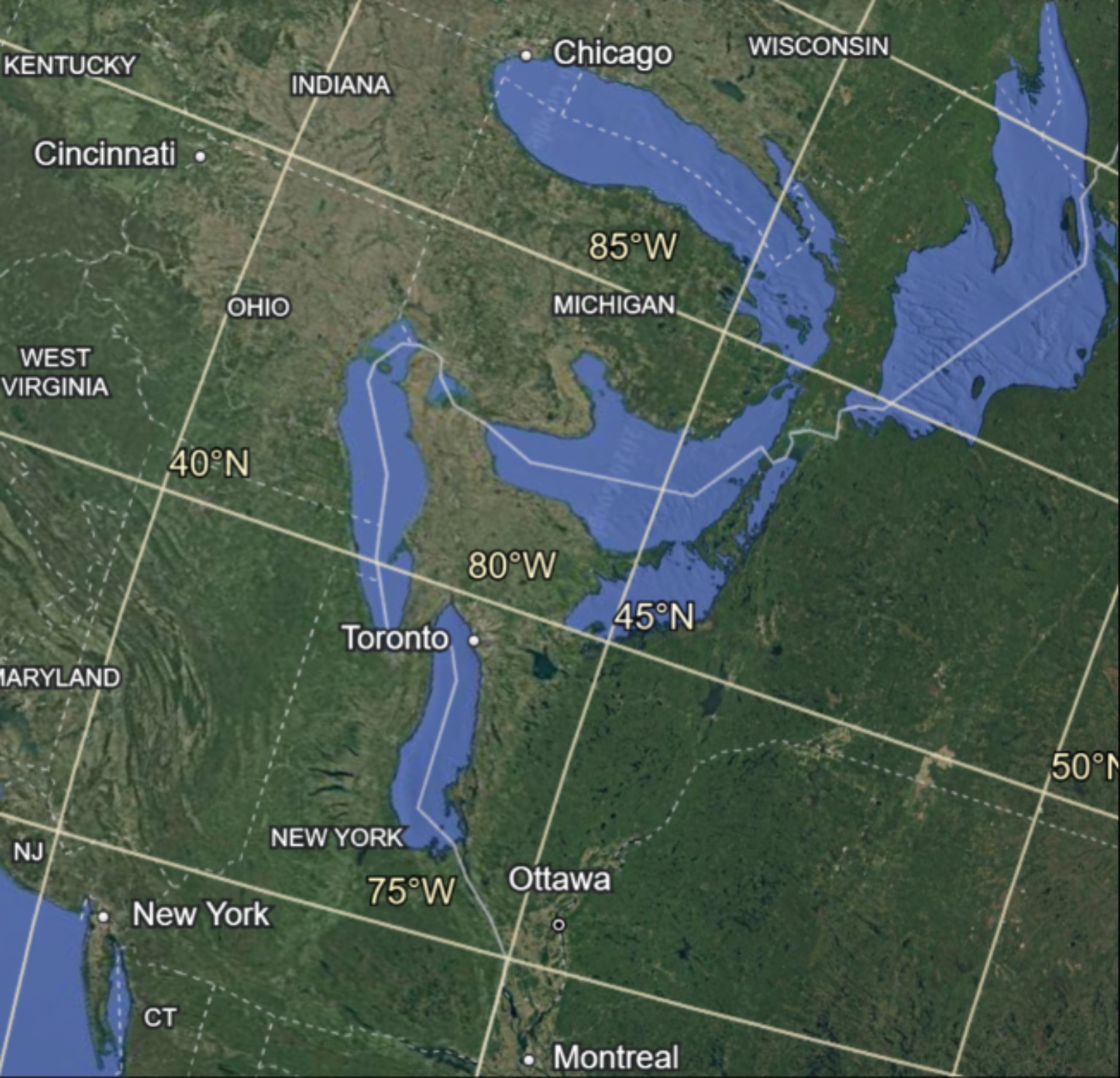
Start with the labeled Michigan landmass, then follow the lakes around it toward Ontario and Toronto. Brett’s reading brings the Canadian landforms and the Michigan–Great Lakes area into a support-and-burden relationship. The shorelines provide the visible setting; the figure and its action are his interpretation of that setting.
This is the original terrain image, not a new anatomical drawing. A character overlay should explain the pose Brett sees while keeping the same landforms visible. No replacement pose or newly invented body-part placement has been added here.
Why the Atlas Mountains matter
The African connection is central to Brett’s reasoning. The Atlas mountain system lies in northwestern Africa, across Morocco, Algeria and Tunisia. Its name and the ancient association between Atlas and a mountain landscape give his Great Lakes figure a second point of connection beyond its supporting posture.
His broader interpretation is that land now separated by the Atlantic may preserve portions of a larger connected form. He links the Canadian and eastern North American landscape to the African side through the history of continental separation. This is why Atlas is not presented simply as an isolated resemblance near Michigan: it belongs to his wider reading of figures and relationships across continents.
The geological connection
There is an established geological context for looking across the Atlantic. The National Park Service describes the Appalachians as part of a continental-collision zone that also includes the Atlas Mountains in Africa. North America and Africa were joined within Pangaea before rifting and the opening of the Atlantic separated them. Its account places the beginning of that breakup toward the end of the Triassic. Read the NPS account of Pangaea and the connected mountain belts →
That shared tectonic history gives Brett a real geographic connection to consider. Reading the separated landscapes as parts of an Atlas figure is his additional interpretation. The geological connection does not itself identify a body, and the Great Lakes figure is not interchangeable with the Appalachian mountain belt.
Atlas in the ancient stories
The burden-bearing Titan. Hesiod’s Theogony describes Atlas supporting the broad heaven with his head and hands. That supporting action is the narrative parallel Brett sees in the landscape. The ancient burden is the sky or heavens; Brett’s “holding up Michigan” and “holding the world” language describes his own geographic reading.
The mountain connection. Ancient traditions also connect Atlas with mountains. In Ovid’s Metamorphoses, Book 4, Perseus transforms Atlas into a mountain: the story describes bodily features becoming parts of the landscape. This is a literary connection between a figure and mountain form, rather than a geological account. Read the collected ancient Atlas passages →
Hercules and the shared burden. In Pseudo-Apollodorus, Library 2.5.11, Heracles temporarily carries the heavens while Atlas obtains the apples of the Hesperides. That is a genuine narrative relationship between the two figures. Within Continental Titans, it provides a connection to Brett’s separate Hercules interpretation at the northwest African and Gibraltar landscape. Read the ancient account → · Explore Hercules →
How the connections come together
- The visible landscape: Canada, Ontario, Toronto, Michigan and the Great Lakes provide the setting for the mapped figure.
- The action Brett sees: a supporting or burden-bearing pose leads him to Atlas.
- The African connection: the Atlas Mountains and the history of joined continental margins extend his interpretation across the Atlantic.
- The ancient comparisons: Atlas carrying the heavens, Atlas becoming a mountain and Hercules sharing his burden supply distinct narrative connections.
These are the reasons for Brett’s identification. The dossier presents his interpretation alongside the geography and literature that inform it. The ancient texts do not locate Atlas in Canada or identify Michigan as his burden.
Sources behind this dossier
- Brett’s original project account: Titan Atlas Framework, May 20, 2026. The Canada/Toronto, Michigan and Africa statements above are preserved from his own messages.
- Original project imagery: the Great Lakes source terrain frame reproduced above, retaining its map labels and viewing direction.
- National Park Service, “Supercontinent Pangea”: continental collision, connected mountain belts and Atlantic opening.
- Theoi, Atlas: collected classical passages: Hesiod’s sky-bearing Atlas and Ovid’s mountain transformation.
- Pseudo-Apollodorus, Library, Book 2, section 2.5.11: Heracles, Atlas and the Hesperidean apples.
Geographic history and ancient literature are identified as such. The mapped figure and its connections across continents are Brett Rosiere’s interpretation.