The Great Knife-Wielding Ape · Dossier article
Tools, generations and the African landscape
Hominin fossils, stone and bone tools, and the Rising Star cave provide the documented histories alongside Brett’s continental interpretation.
← Dossier indexA continent of distinct histories
Brett connects the scene of a primate, a held smaller figure and a tool with Africa’s rich record of human origins and toolmaking. These connections give the dossier its theme: bodies, generations, learned actions and objects that change what their users can do.
The finds discussed here come from different sites and widely separated periods. They are not one assemblage or evidence of a single event. Their scientific importance stands independently of the Great Ape interpretation.
Fossils and their places
At Hadar in Ethiopia, Lucy (AL 288-1) is an approximately 3.2-million-year-old Australopithecus afarensis skeleton. Aramis in the Middle Awash preserves the much older Ardipithecus ramidus remains commonly known as Ardi, around 4.4 million years old. These are distinct fossil individuals, taxa and contexts.
Herto and Omo/Kibish preserve much younger Homo sapiens remains. Their ages depend on their own stratigraphic and geological relationships. In particular, the revised minimum age of Omo I comes from correlation of an overlying volcanic deposit, not a direct measurement of the skeleton. That age must not be transferred to Herto or other Ethiopian sites.
Further south, the Fossil Hominid Sites of South Africa include important cave deposits and hominin discoveries. The contrast between southern cave deposits and eastern open-air or sedimentary settings is part of the landscape’s history, not a reason to merge their records.
Stone and bone tools
Lomekwi 3 in Kenya preserves stone tools dated to about 3.3 million years ago. Gona in Ethiopia is known for approximately 2.6–2.5-million-year-old stone tools. These discoveries document early technology, but a nearby fossil cannot automatically be named as the maker of a particular artifact.
At Olduvai Gorge in Tanzania, research describes systematic production of bone tools about 1.5 million years ago. Bone and stone preserve different kinds of information about raw-material choices and manufacture. The tools discussed at these eastern African sites are not finds from the Dinaledi Chamber at Rising Star.
The wider comparison is not limited to knives. Cutting edges, pounding tools, shaped bone, wood and other materials have different uses and preservation histories. A named site can include many occupations and layers, so the age and context of each object remain important.
Rising Star, Homo naledi and the ear comparison
The published Rising Star cave survey describes a real cave system in South Africa. Homo naledi fossils from its Dinaledi Chamber are a separate, documented paleontological discovery. The published depositional age range for the Dinaledi material is 335,000–236,000 years ago.
Brett sees a visual resemblance between aspects of the cave’s form and an ear. The film places the published cave survey beside an OpenStax human-ear diagram so readers can see the comparison he is making. The images are at different scales and are not aligned to one another. A resemblance does not identify the cave as an anatomical ear, and the comparison does not establish a measured cave-to-ear position on the continental artwork.

The cave survey retains its original plan and section orientations. Its geological depth section should be read as published, rather than turned into the south-up orientation of the continental maps.
Reading the archaeological maps
The atlas places records of hominin remains, lithic evidence, organic tools and other technology in their wider African setting. Some points are approximate regional anchors rather than excavation coordinates. Several records may refer to the same place, to different layers at one site, or to later analyses of the same material.
The overlays help readers move between the large scene and named places. They do not assign the discoveries to biological body parts or make every plotted marker an independent finding. Geology, burial conditions, erosion, access and the history of fieldwork all influence what survives and where it is found.
Tools, learning and generations
An action changes material; the resulting object changes what its user can do; and practice can shape later actions. Knapping scars and refitted flakes can preserve parts of a manufacturing sequence. These are traces of activity, not a complete record of a maker’s thoughts.
Observation, teaching and surviving artifacts can carry practices between people. This is why tools and generations are central to Brett’s reading of the scene. Cultural learning, biological inheritance and the physical survival of an artifact remain different processes, even when they are considered together.
Sources and further reading
- Smithsonian: Introduction to Human Evolution
- Smithsonian: Lucy, AL 288-1, from Hadar
- Suwa et al. (2009): The Ardipithecus ramidus skull and its implications for hominid origins
- White et al. (2003): Pleistocene Homo sapiens from Middle Awash, Ethiopia
- Vidal et al. (2022): Age of the oldest known Homo sapiens from eastern Africa
- Semaw et al. (1997): Stone tools from Gona, Ethiopia
- Harmand et al. (2015): 3.3-million-year-old stone tools from Lomekwi 3
- de la Torre et al. (2025): Bone-tool production at Olduvai Gorge
- UNESCO: Fossil Hominid Sites of South Africa
- Dirks et al. (2015): Rising Star cave survey, Figure 2
- Berger et al. (2015): Homo naledi fossil assemblage, Figure 1
- Dirks et al. (2017): The age of Homo naledi and associated sediments
- OpenStax: “1404 The Structures of the Ear,” Anatomy and Physiology
Images for this article
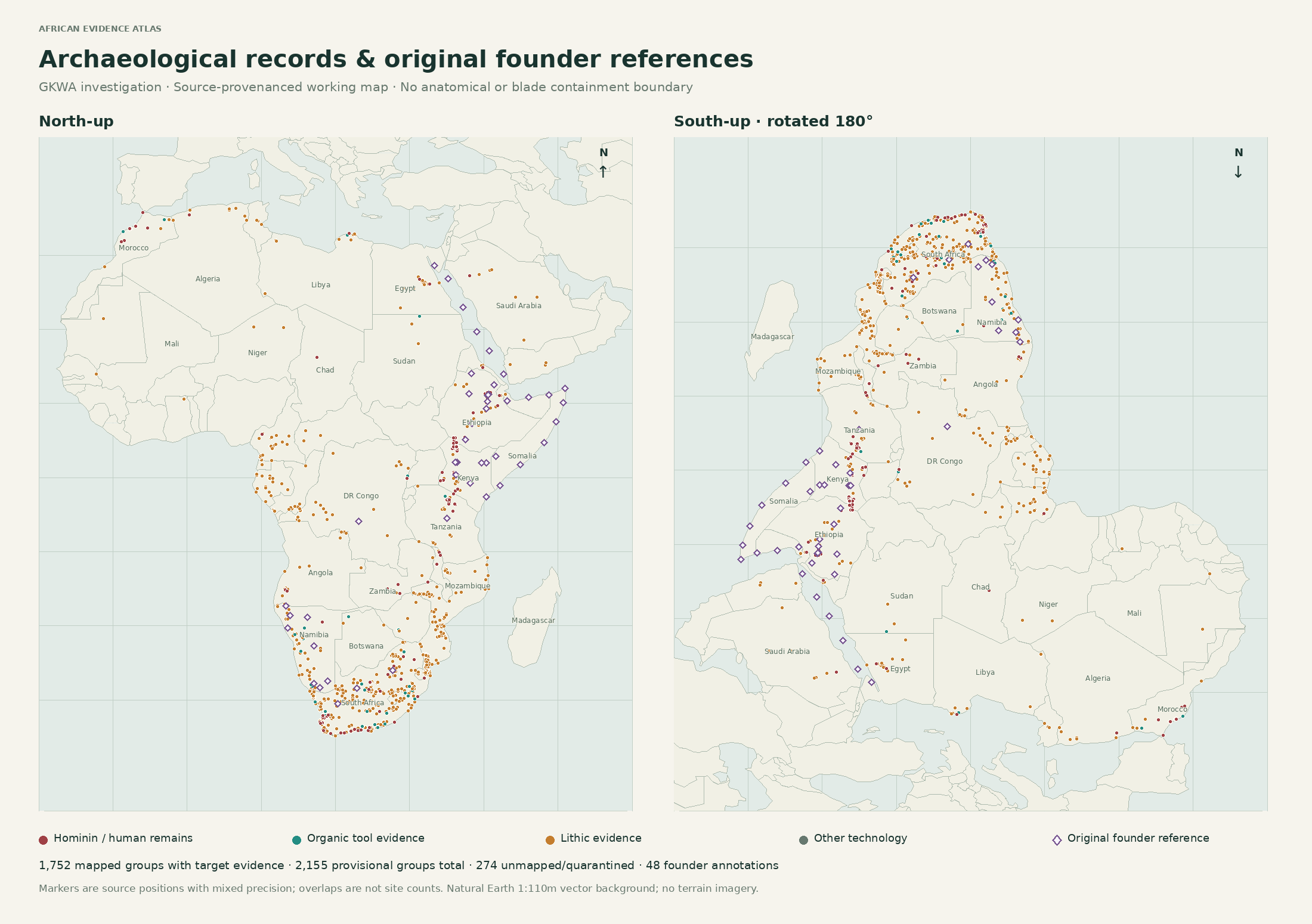
Archaeological research map
Hominin and tool records across Africa
A source-based location atlas, shown north-up and south-up, distinguishing hominin/human remains, organic tools, lithic evidence and Brett’s reference annotations.
Map markers have mixed location precision and may represent repeated locations or analyses. They are not a count of independent discoveries or anatomical assignments.
Open the complete image →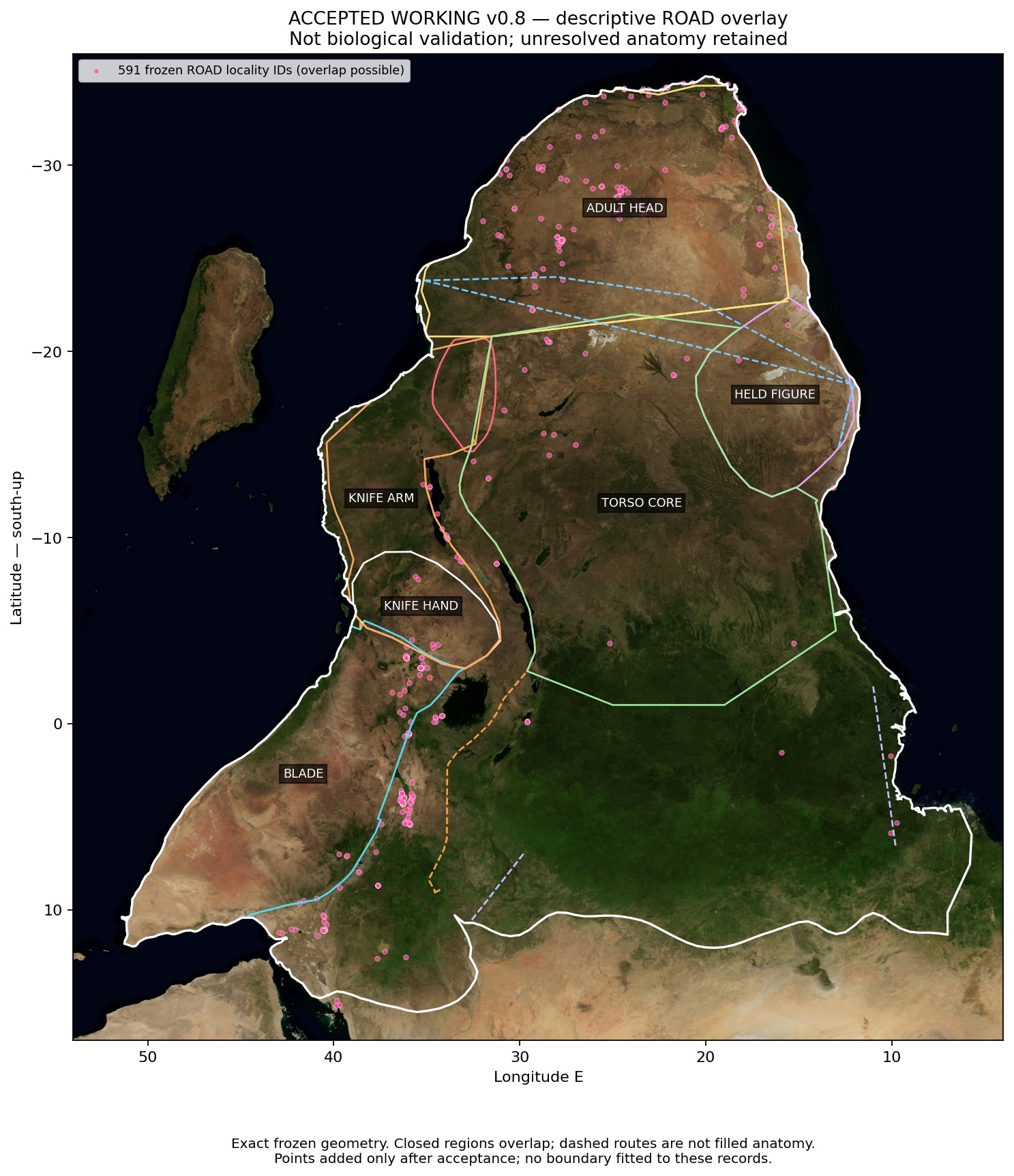
Archaeological research map
Selected ROAD locality records
Selected ROAD locality records shown alongside the project’s interpretive outlines.
The source map allows overlapping records. Locality identifiers are not a count of independent excavations or fossil specimens.
Open the complete image →