The Great Knife-Wielding Ape · Dossier article
Recursion, the held figure and the Logos
The adult, the held figure and the tool bring together Brett’s themes of relationship, inheritance, learning and creation.
← Dossier indexA scene within a larger history
The Great Ape interpretation places an adult, a smaller held figure and a tool in one landscape. Brett connects that arrangement with smaller African histories of bodies, generations and toolmaking. The appeal is relational: what one figure holds, what a tool enables, and how living things change their surroundings.
The held figure gives the scene a generational theme. The implement introduces deliberate action and the transformation of material. Together they form Brett’s reading of the artwork; they do not establish a biological lineage between a continental being and ordinary hominins.
Repetition, self-similarity and recursion
Repetition means that something recurs. Self-similarity means resemblance across scales. Recursion describes a process whose next step depends on a preceding step or result. Feedback occurs when an output influences later behavior. These ideas can overlap, but they are not interchangeable.
Brett uses recursion as a way to think about histories that remain active in what follows. A river channel guides later water. A tool changes a task, and practicing the task changes later actions. A learned method can influence what a later generation attempts. Calling such persistence “memory” does not mean that a channel or stone is conscious.
Different ways the past persists
Geological traces, biological inheritance and cultural learning retain history through different mechanisms. Sediments can preserve earlier environments. Bodies inherit biological information. People can learn techniques from other people and from artifacts. Their differences matter as much as their shared theme of continuity.
The project’s Recursive Constraint–Information Model, or RCIM, is a conceptual framework for discussing state, retained history, constraints and environment. Here it supplies vocabulary for Brett’s interpretation. It is not presented as an established physical law or as an explanation that makes every recurring shape biological.
The Logos and personal meaning
Brett understands creation through the Logos, the Christian Word. The relationships of life, form, inheritance and meaning are part of his testimony and explain why these landscapes matter to him.
Faith and interpretation can be stated openly alongside the documented geography and archaeological discoveries. The sources describe particular rocks, places, objects and fossils. The larger spiritual and continental reading belongs to Brett. Keeping that distinction clear allows readers to encounter both the testimony and the evidence in their own terms.
Sources and further reading
Images for this article
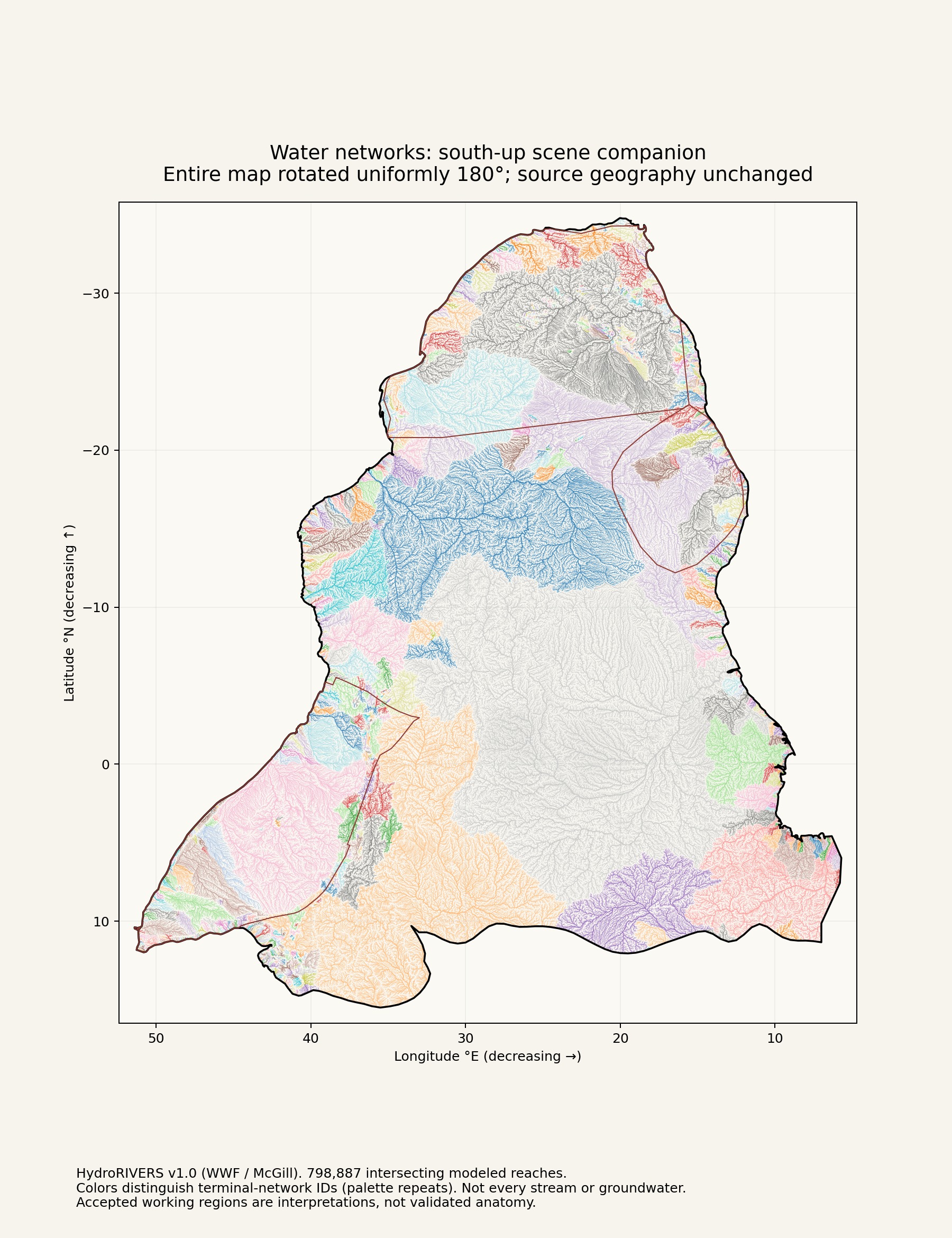
Hydrological research map
Rivers across the whole scene
HydroRIVERS regional river-network context.
The river network is geographic data; the overlaid regions follow the proposed scene.
Open the complete image →