Antarctica
Washington of Antarctica
A left-facing portrait, a southern dragon scene, and a journey into the ancient stories of confinement and judgment.
← All discoveriesLook at the land. Compare the interpretation.
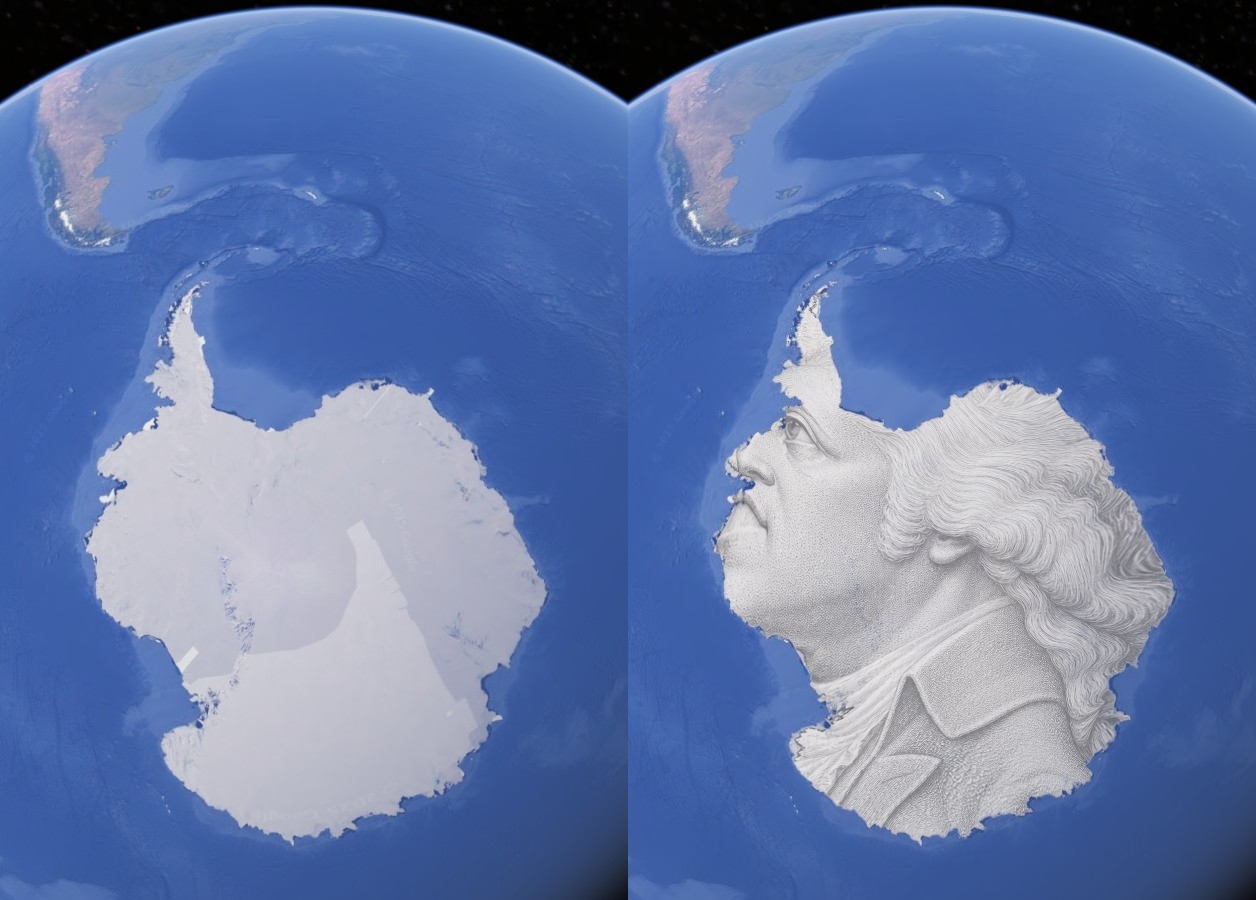
Source imagery and artistic interpretation are distinct. Source screenshots retain their original map labels and controls. Outlines, faces, armor and other added details express an interpretation, not verified geological anatomy.
Brett’s reading
A portrait within a wider scene
Brett compares Antarctica with the left-facing George Washington profile familiar from a quarter. In the project’s early description, the Antarctic Peninsula serves as the proposed nose, the western interior as an eye region, and the eastern mass as hair or a powdered wig. These are his visual associations.
The surviving illustration is a separate artistic treatment. Its facial features do not reproduce every early landmark assignment: the illustrated nose appears farther down the western edge, while the peninsula rises above the forehead. Keeping the whole comparison visible lets readers see that difference rather than silently treating the artwork as a precise map.
On May 5, 2026, Brett described the Drake-region dragon’s proposed right wing as Antarctica/Washington and its left wing as the South American Grinch. This is the wider scene behind the portrait, not a claim that the historical Washington visited Antarctica.
Scripture · Enoch · Greek myth
Why the prison stories enter the picture
The later Antarctic interpretation led Brett to stories of rebellious heavenly beings, confinement and judgment. In 1 Enoch, Azazel is bound in Dudael, while Semjaza and his associates receive a distinct confinement. Hesiod’s Titans are bound in Tartarus. The Greek wording of 2 Peter 2:4 provides a specific literary connection through the verb meaning “cast into Tartarus.”
These connections are worth reading in their own words. They do not name Antarctica as the prison, and the Watchers, their giant offspring and spirits of the dead are different characters in the texts.
Follow the passages and sources →Film and original-image status
No verified, playable Washington discovery film is available in this release. The historical comparison above remains the available visual; no unrelated clip has been substituted.
The earlier marked-profile originals have not been recovered as verified image files here. Later social-media videos discussing Enoch and Antarctica are reference material, not Washington discovery footage or ancient evidence. They are not embedded in this page.
Research and connections
Read the latest available findings, comparisons, limitations and sources for this discovery.
Explore the research →