The whole scene
Begin with the adult, the held figure and the two arms. Their proposed relationships matter as much as any single resemblance.
New to the Great Knife-Wielding Ape? Compare the south-up terrain and working maps, then explore the hypothesis and selected research. Start here →
Africa · South-up view
One landscape. A proposed adult, a held figure, a blade, and the histories within them.
Begin with the source view
Brett reads Africa turned south-up as a connected scene: a large primate, a smaller figure held by one arm, and a broad blade held by the other. What people call the Horn of Africa is what Brett considers the blade of the Great Knife-Wielding Ape. The dossier follows that reading from the whole landscape into its individual features, bringing together the source maps, archaeological discoveries and interpretive connections.
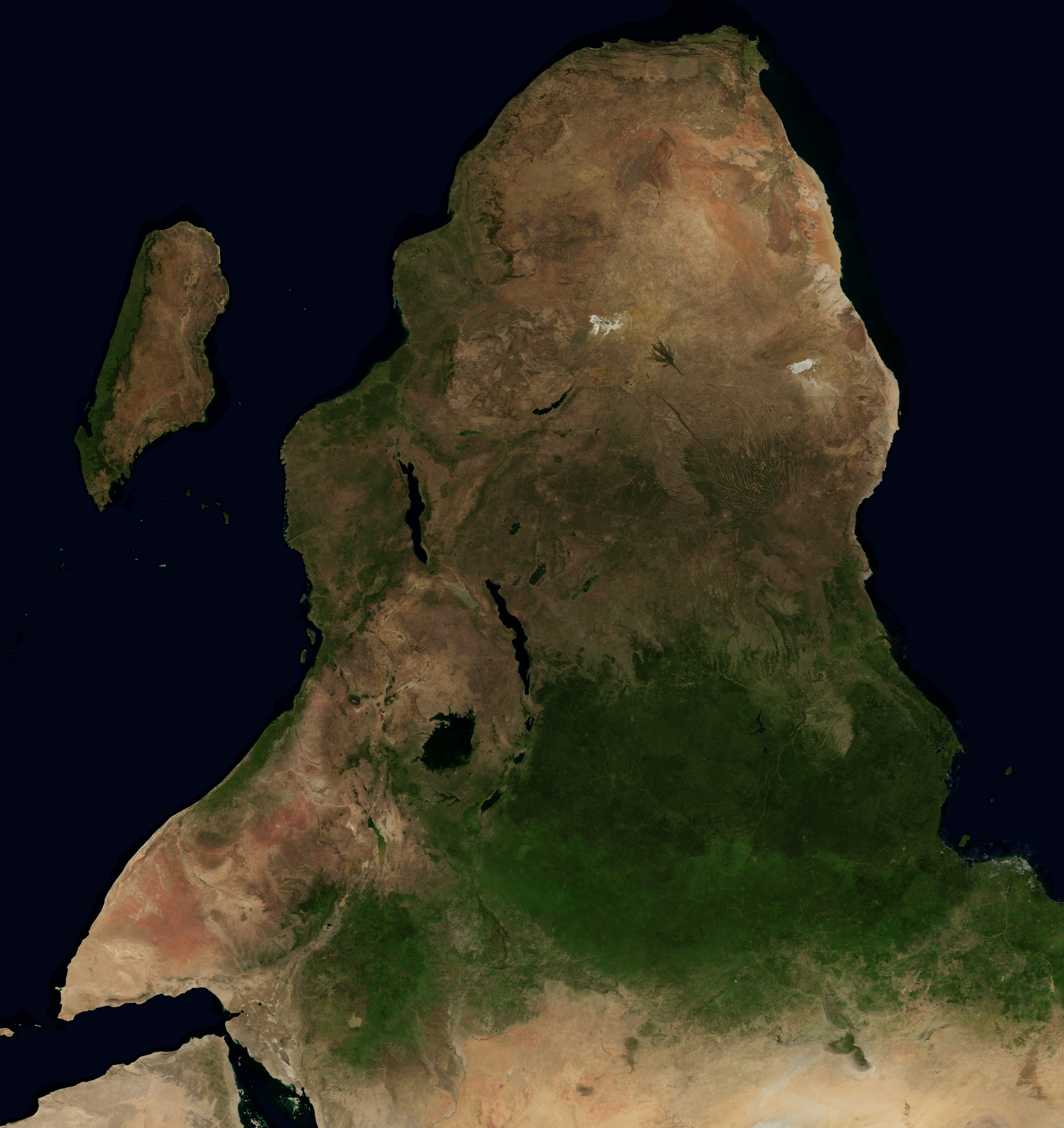
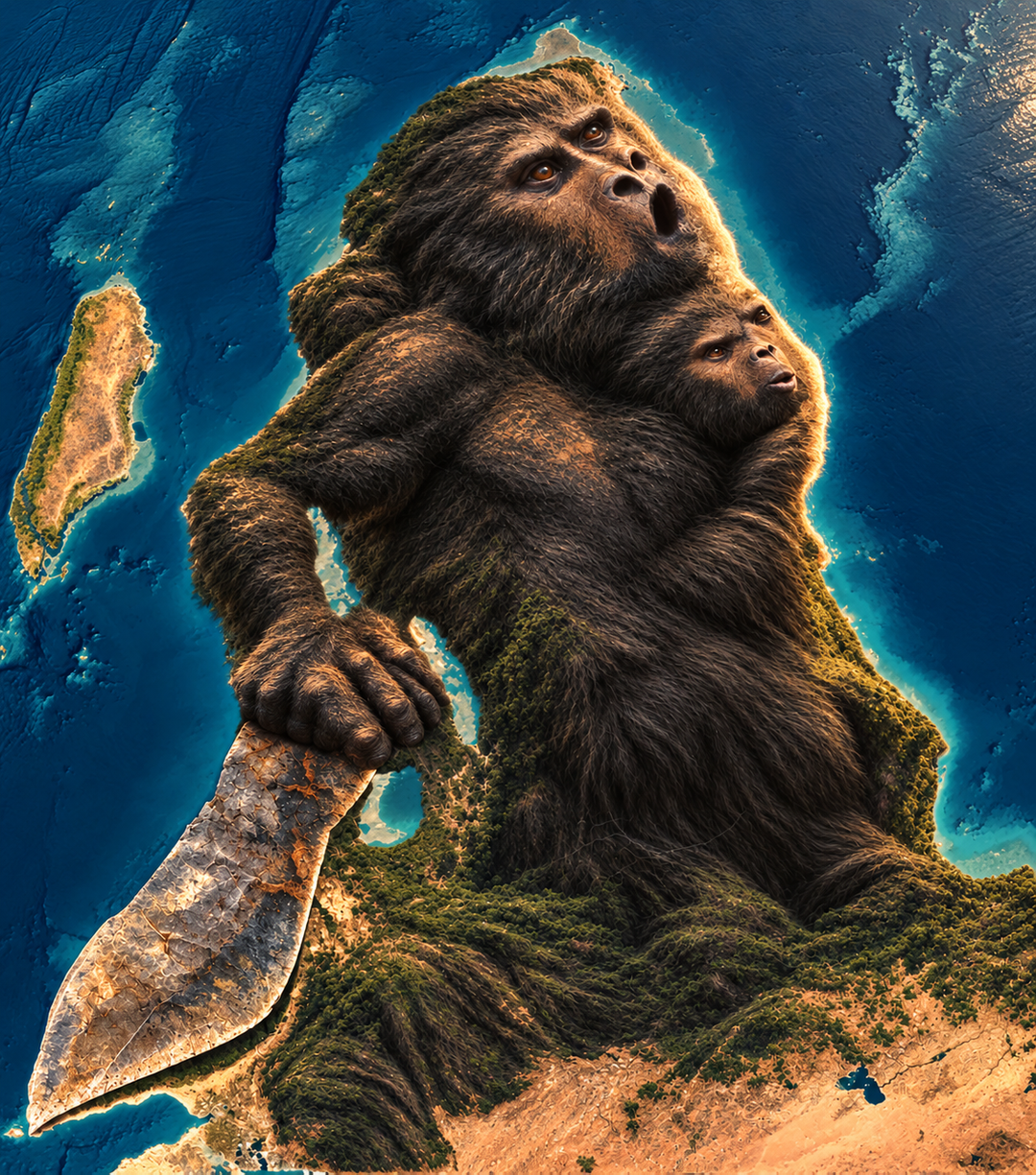
The terrain and artwork are separate sources. Artistic detail shows Brett’s interpretation; it is not independently observed anatomy. The selected images retain their original framing and labels. The image atlas adds annotated source views, artwork and research maps.
A guide to the scene
Begin with the adult, the held figure and the two arms. Their proposed relationships matter as much as any single resemblance.
Brett interprets the Horn of Africa as the blade. The dossier follows that interpretation alongside the region’s geography and discoveries.
Explore human origins, tools, water, geology and ecology without treating connected layers as independent proof.
Open the whole collection
Follow the artistic readings into the mapped archaeological record and the landscapes behind the discovery.
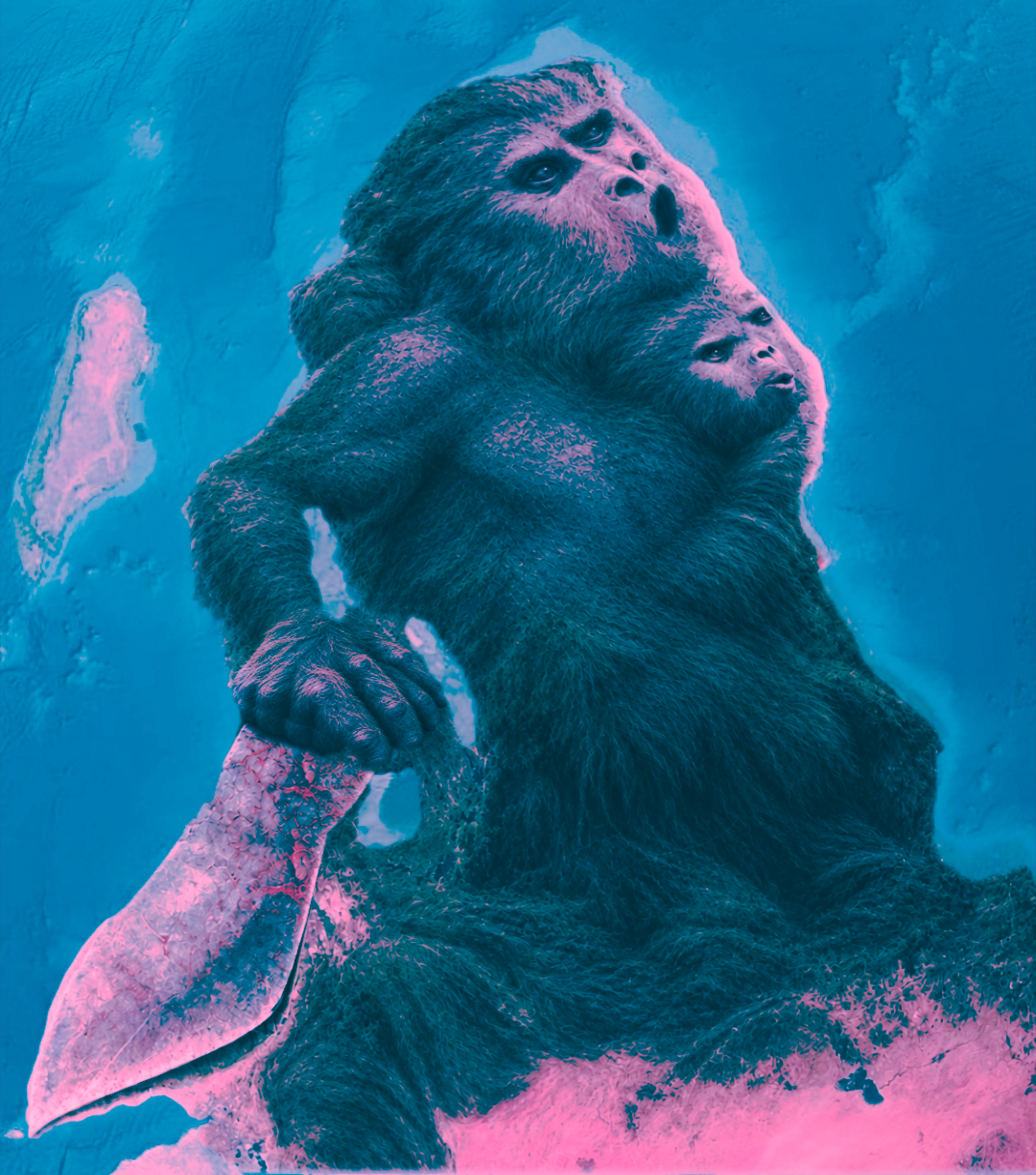
Artistic overlay
The supplied magenta-and-blue artistic reading of the whole scene.
Artistic colors and anatomy are added to the scene. Its framing differs from the registered basemap.
Open the complete image →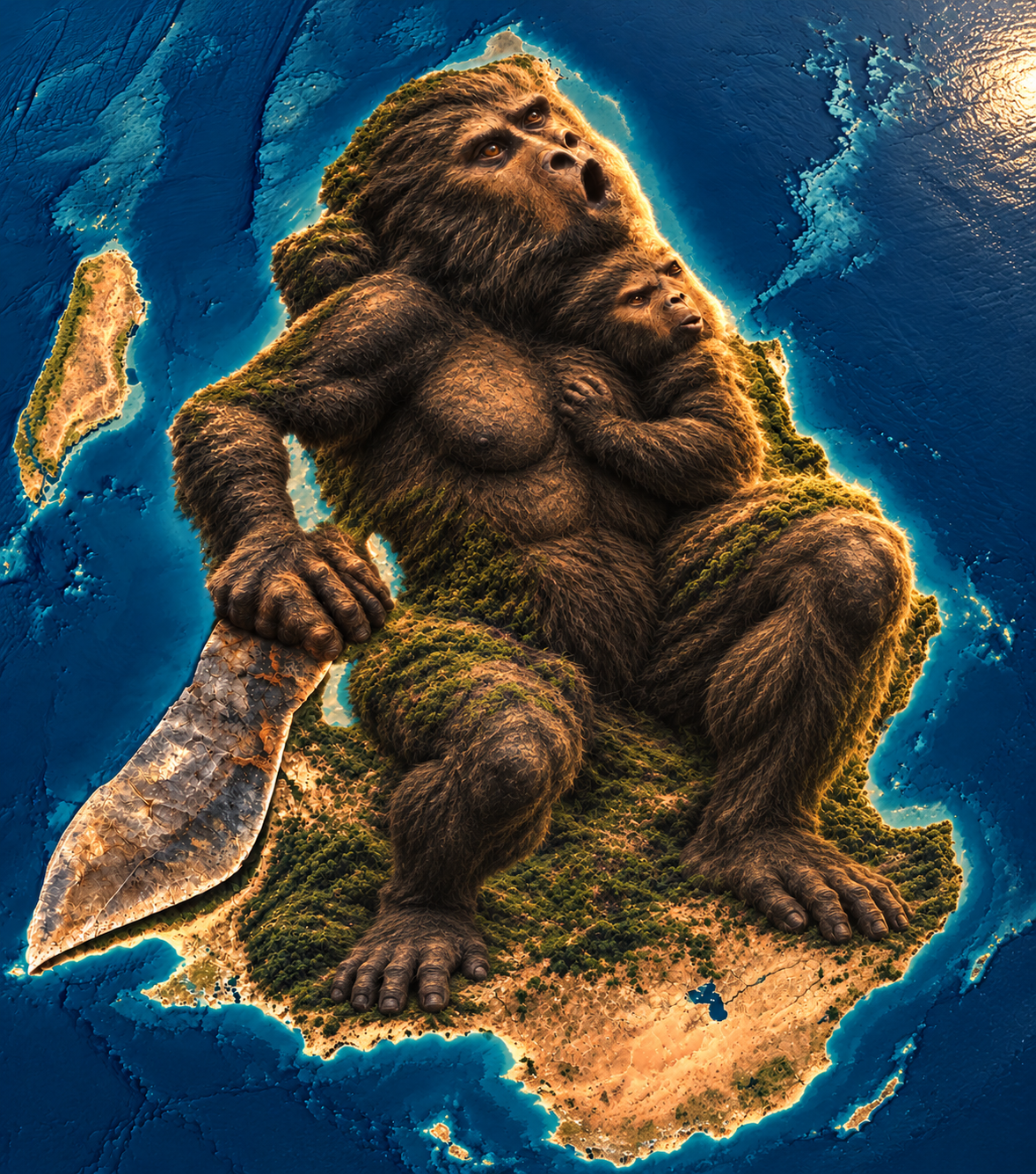
Concept art
An expanded full-body artistic interpretation.
An imagined whole-body posture, rather than a terrain-locked reconstruction.
Open the complete image →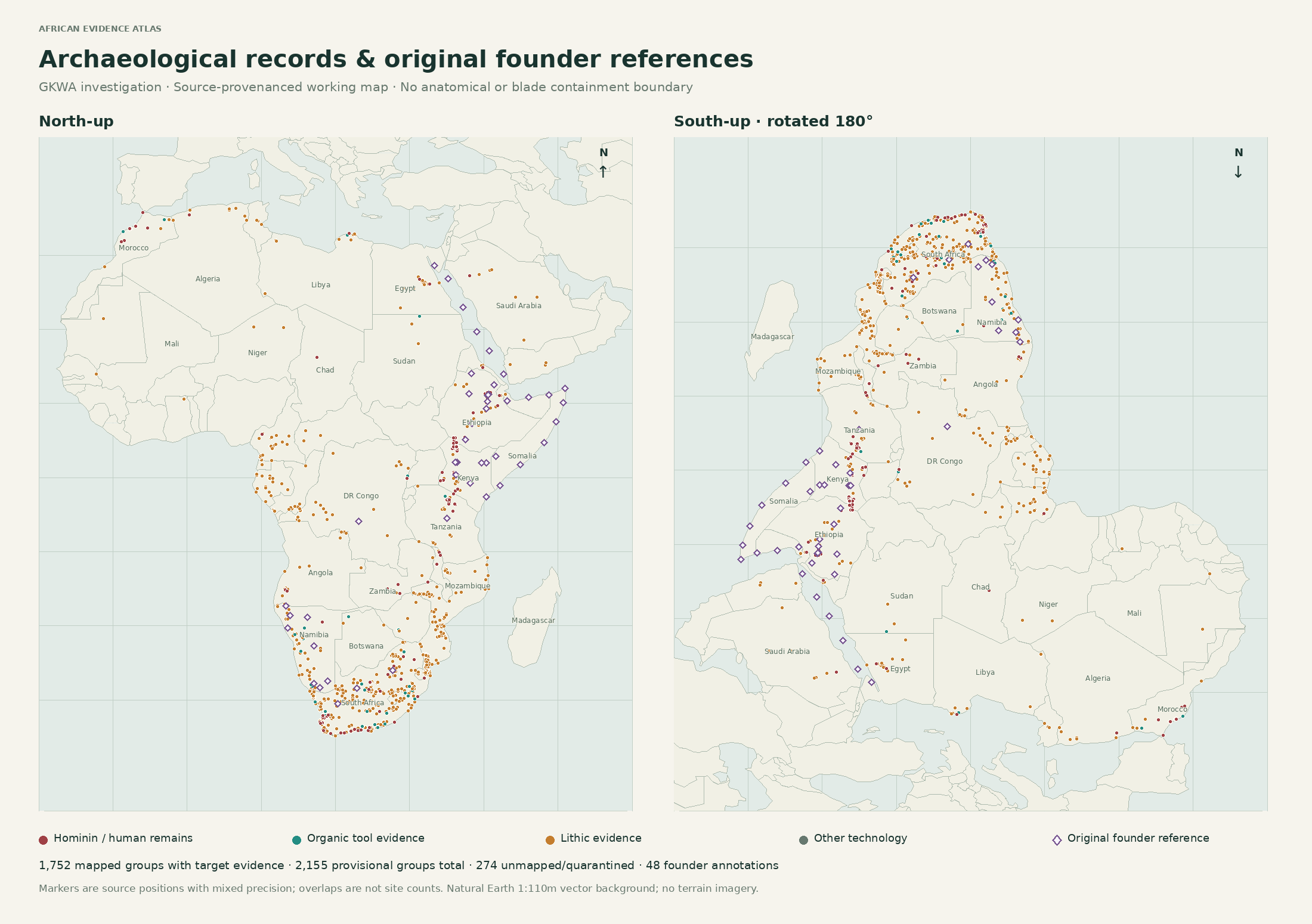
Archaeological research map
15 October evidence atlas, shown north-up and south-up, separating hominin/human remains, organic tools, lithic evidence and founder annotations.
A working register with provisional location groups. Records may refer to repeated locations or analyses; these locations do not establish anatomical boundaries.
Open the complete image →The narrated discovery film · 4:34
Travel through south-up terrain, Brett’s artistic overlays, African fossil and tool discoveries, a visual cave-and-ear comparison, and the changing Rift landscape.
Brett’s interpretation: the Horn of Africa is the blade of the Great Knife-Wielding Ape. Geographic names and archaeological findings are presented alongside that reading, rather than as established anatomical identifications.
Open the complete narrated film → · Film sources and image credits →
Existing source imagery and artwork, published scientific illustrations and synthetic narration. The cave-and-ear comparison is a visual resemblance at different scales. The animated Rift map is an illustrative tour, not footage of ground motion.
Two original recordings
This complete 49.5-second source recording, uploaded in October 2026, follows satellite Africa through colored overlays into the interpreted Ape-and-blade scene. The TikTok preview interface is part of the original recording.
Open the full overlay recording →
A separate full-length screen recording follows the terrain through a Google search and Google Earth. It provides geographic context for the discovery rather than the colored-overlay sequence above.
Open the full terrain walkthrough →
Both recordings retain the source audio and complete sequence. The terrain walkthrough is a web-optimized copy of the highest-resolution verified version.
Continue into the research
Each article follows one part of the discovery, with its source history, interpretation and open questions kept together.
Article 01
The adult, supporting arm, held figure and broad blade belong together. Read the scene through the source terrain and artwork.
Read the article →Article 02
Real archaeological discoveries give the scene its setting. Spatial correspondence and a shared biological history are different claims.
Read the article →Article 03
Explore the Horn of Africa, the Red Sea and the East African Rift, with geological history and Brett’s interpretation kept distinct.
Read the article →Article 04
The adult, held figure and tool invite a reflection on life, generations and the Logos.
Read the article →