A versioned map
The approved exterior and accepted working regions are preserved with their source files. The original 48 placemarks are historical starting observations, not the current map’s point count.
Continental Titans · Start here
The Great Knife-Wielding Ape
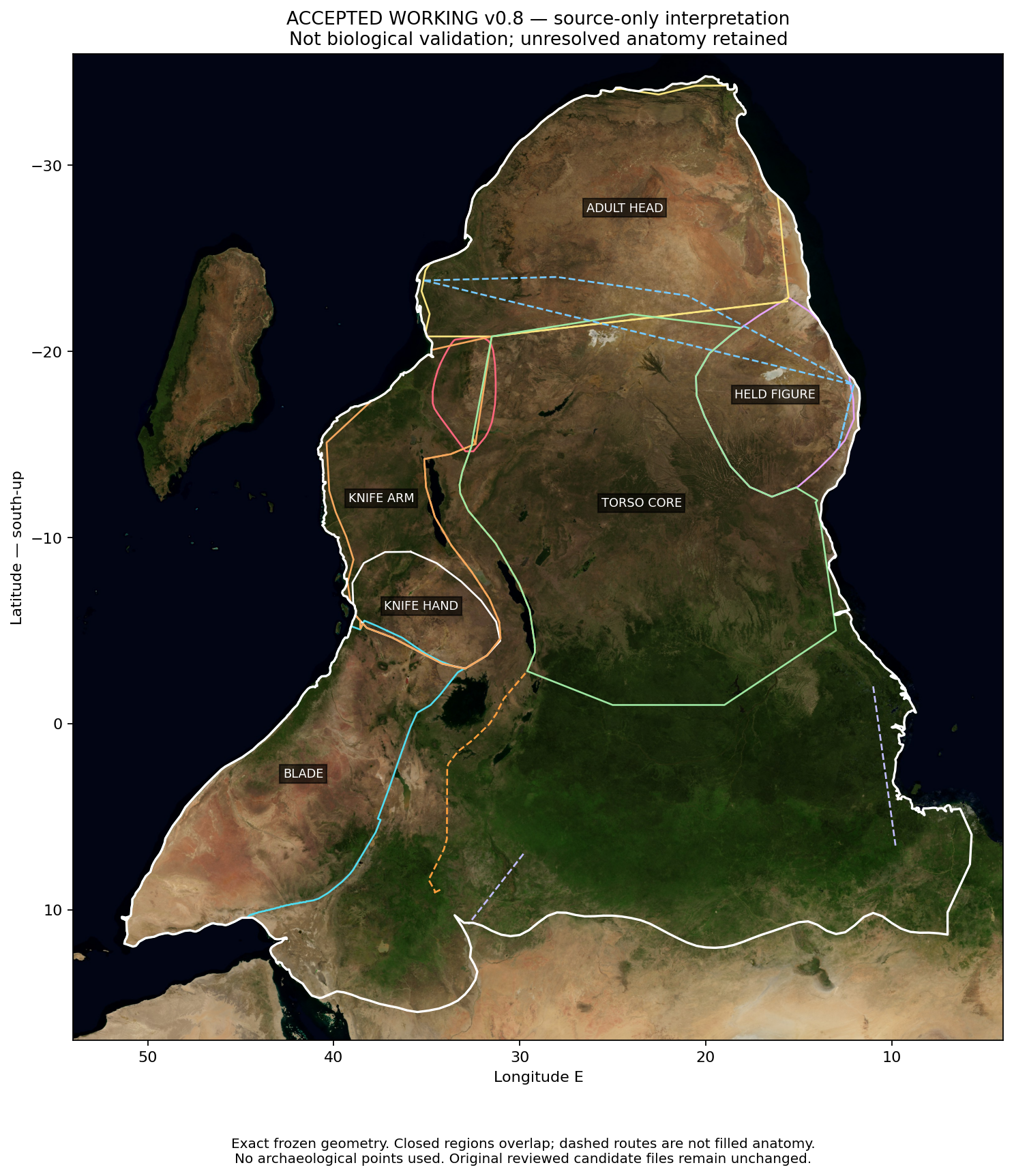
In a south-up view of Africa, Brett Rosiere interprets a large primate-like figure holding a broad blade in one hand and a smaller figure in the other. Inside the blade, he identifies another human-like form.
The inquiry follows those relationships into toolmaking, human origins, care, Scripture, and responsibility.
01 · Begin with the geography
Changing the viewing direction does not change the land. Compare the terrain with its matching overlay immediately beside it—or directly below it on a phone. Both views show the same area with south at the top.
The hand belongs at the base of the blade. The Red Sea is a separate proposed cut. The map records a geographical interpretation, not surveyed biological tissue.
02 · Why the relationships matter
Actual fossils and archaeological technologies occur across these African landscapes. The book brings their history of making, learning, and inheritance into conversation with the larger proposed tool-bearing figure.
The resemblance between those scales is part of Rosiere’s hypothesis. Archaeological co-location does not by itself establish a continental organism.
The held figure changes the interpretation of the scene. Alongside the power to act with a tool, the image raises questions about dependence, protection, teaching, and what one generation passes to the next.
These themes connect the work to children, stewardship, moral knowledge, and the consequences of human capability.
Continental Titans is rooted in Rosiere’s Christian faith and desire to give glory to the Creator. His reading connects the scene with Genesis, human origins, Eden, and a wider investigation of scriptural and mythological imagery.
The project explores how evolution and belief in creation can be discussed together. Textual interpretation and physical evidence each retain their own questions.
03 · What has been done
The approved exterior and accepted working regions are preserved with their source files. The original 48 placemarks are historical starting observations, not the current map’s point count.
The whole-scene membership replay places 51 of 63 selected July archaeological entries and 1,622 of 1,881 mapped archive rows inside the approved exterior. Those are different inventories; archive rows are not all independent sites.
Regional comparisons, terrain studies, hydrology, ecological overlays, and statistical sensitivity checks are documented in the companion. Their methods and limitations matter as much as the totals.
Rosiere’s preferred explanation is biological. The available results do not establish that Africa is the body of an organism or that a literal continental cutting event occurred. The physical proposal requires additional anatomical, material, chronological, and mechanical evidence.
Unresolved landmarks and independent recognition testing remain explicit research questions. The theological and symbolic readings are developed alongside them.
04 · Explore selected research
Brett Rosiere’s interpretation
Rosiere interprets the larger figure, full blade, held figure, and smaller form inside the blade as parts of one scene. His preferred explanation is biological; he also investigates whether shared formative principles could explain recurring patterns across scales.
He connects these observations with human origins, toolmaking, care, moral responsibility, and his Christian belief in creation. These are the project’s hypotheses and interpretations, not established findings of continental biological identity.
Explore the selected research →Approved exterior GeoJSON · Working regions GeoJSON · Original acceptance manifest
The October 20 acceptance supersedes “candidate” wording in the original internal-map filenames. It records a working interpretation, not biological validation.
05 · An invitation to examine
You do not have to accept the whole interpretation to help examine one part of it.
When responding, identify the chapter, feature, or source you mean, describe your reasoning, and include a source or a reproducible method where possible.
Join the conversation on TikTok ↗
Brett Rosiere · Continental Titans
Faith, discovery, and an open invitation to look closely.