Prometheus & the
Atlantic Water-Bird
Follow Brett’s reading of Central America, the surrounding chain-holders and the approaching bird. Compare Brett’s bird and Prometheus separately or together on the same terrain.
Compare the water-bird and Prometheus
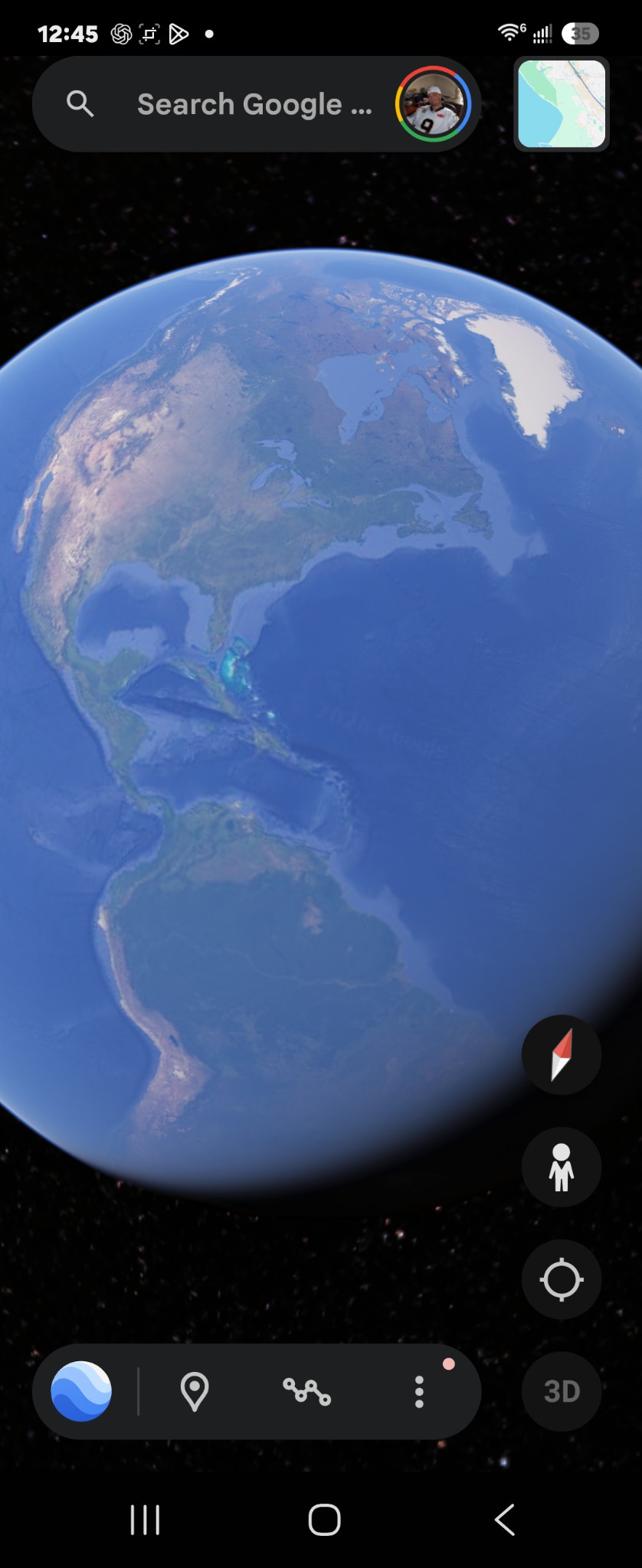

The terrain stays fixed. Use each slider to show or hide its artwork.
Both layers use the same November 3 Google Earth registration view. The bird artwork is isolated from the full scene to show its placement over the Caribbean and western Atlantic. The terrain-only view is a prepared source copy. The artwork illustrates Brett’s interpretation.
See the progression
Terrain → partial overlay → terrain again → complete artistic scene.
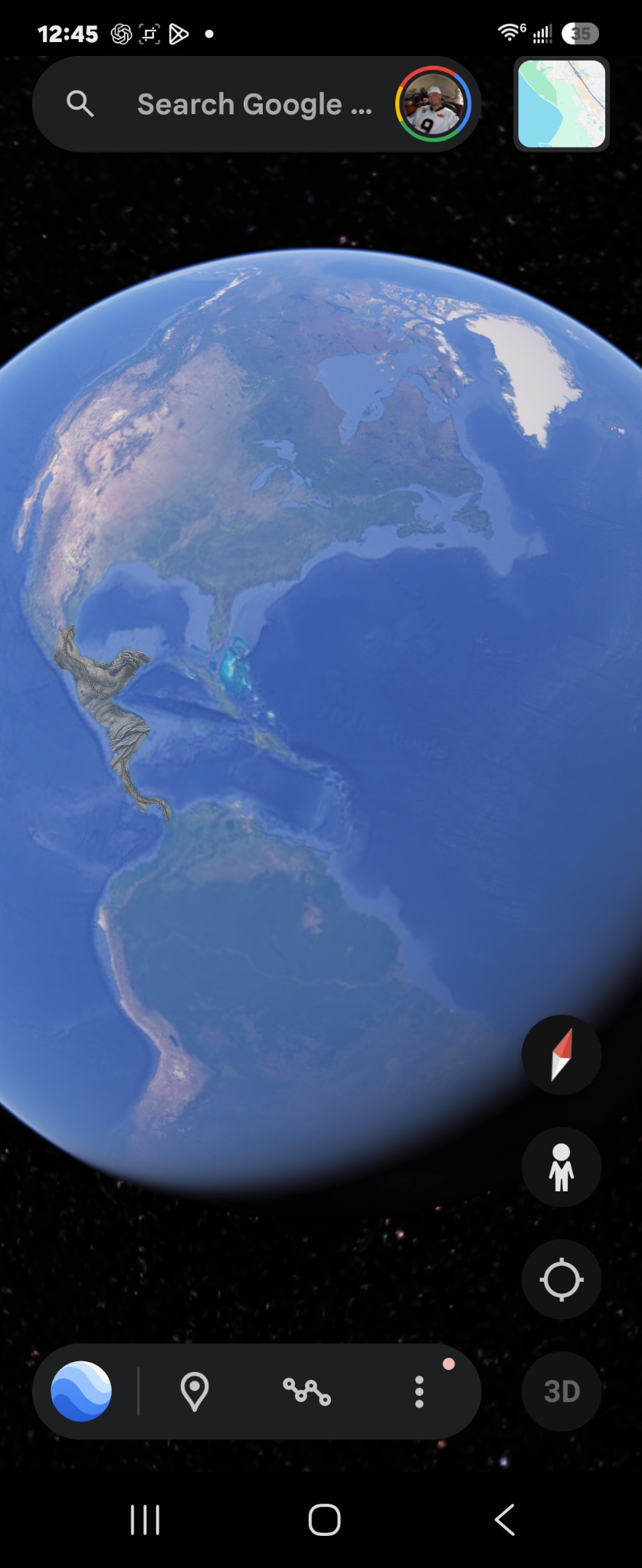
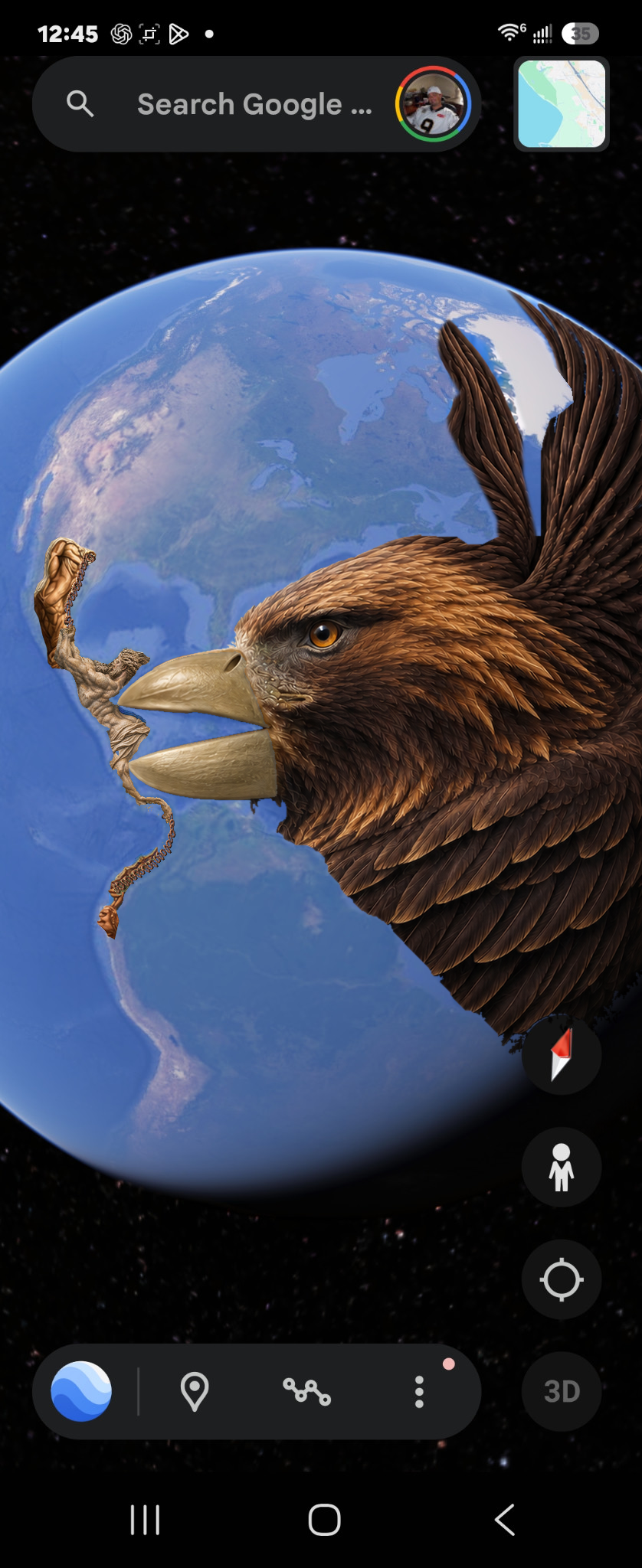
This page presents Brett’s Continental Titans interpretation: Central America becomes the restrained figure of Prometheus, the surrounding Americas hold the chains, and an Atlantic/Caribbean bird reaches toward the figure. The discovery is a reading of relationships across terrain: a captive, restraints, an approaching beak, and two larger figures at the ends of the scene. The artwork makes that reading visible; it does not turn the artwork into an unaltered terrain observation.
Reading the scene
Start with the globe without the illustrated figures. Central America is the connecting land corridor between North and South America. In Brett’s current interpretation it is the compact Prometheus figure, rather than a body made from both entire continents. Move next to the full-scene artwork: the figure’s constrained posture, the surrounding chain paths, and the bird’s open beak organize the scene as an action rather than an isolated resemblance.
The retained project labels include arms, eye, lower body and legs. Early native Google Earth project screenshots document that these labels belonged to Brett’s scene before later assistant-estimated coordinates were proposed. The exact coordinates of those original points have not been recovered. In particular, no precise source point identifying a liver has been recovered. The liver language therefore describes the mythic interpretation of the bird’s target, not an anatomical measurement.
The bird has its own history. The project calls it the Atlantic Water-Bird, with Great Bird of Prometheus retained as an older alias. November artwork renders it as an eagle, with a beak reaching toward Central America and broad wings rising around Greenland. That rendered eagle is an artistic presentation of the project’s bird interpretation, not a photograph of an eagle-shaped landform.
The two chain-holders
The North American chain-holder carries Brett’s adopted project name Kratos, also spelled Cratos. The South American figure holds the opposite chain and remains a separate figure. Bia is a candidate comparison, not a confirmed adopted name. The two figures should never be merged or described as alternate locations of a single character.
The South American work preserves specific artistic constraints: the arm follows the coastline, the hand approaches the peninsula tip, and the fingers curve inward or beneath the ledge. The marked reference used red for the arm, yellow for the hand, and blue for the elbow. Earlier versions that extended beyond the intended terrain or added an unwanted hair/hat silhouette were rejected. These details belong in the discovery history because they explain how the overlay was refined against Brett’s intended view.
In the opening of Prometheus Bound, Kratos and Bia accompany Prometheus, while Hephaestus performs the binding under Zeus’s command. These roles make the chain-holder comparison meaningful within the ancient story. The ancient text does not place those characters in North and South America. Prometheus Bound.
Fire, suffering and the gift to humanity
Fire is central to the comparison, not an optional decorative theme. In Pseudo-Apollodorus, Prometheus gives humanity fire concealed in a fennel stalk. Zeus then has him bound on Mount Caucasus. The eagle consumes his liver by day and it grows back by night; Hercules eventually releases him. The older project video says the attack happens every night. That wording is preserved in the historical video, but this dossier follows the source’s day/night distinction. Library 1.7.1, Perseus.
Brett’s comparative reading brings together knowledge given to humanity, transformative fire, suffering, restraint and eventual liberation. The correspondence is thematic and visual. It does not establish that ancient American peoples called this landscape Prometheus or shared a literal account of the same event.
Maya and other peoples of the region
The cultural story must remain geographically specific. Maya history is particularly relevant to the northern part of the project scene: southern Mexico, Guatemala, Belize and adjoining areas. It is not a label for every society from Mexico to Panama. The Met’s regional account distinguishes Classic Maya courts from Teotihuacan and from the later Mexica empire. These are different histories, not interchangeable forms of one civilization. Arts of the Ancient Americas.
The southern part of the corridor needs its own context. Costa Rica and Panama participated in artistic and exchange networks extending toward Colombia. The Met describes independent Central American polities, ritual metalwork, and the southward circulation and reuse of jade objects. This provides context for the scene’s southern geography without extending Maya identity across the entire isthmus. Golden Kingdoms.
The Maya/fire section is an interpretive bridge that Brett specifically requested in the older conversation. It should compare particular ritual meanings and sources, not simply collect every reference to fire. UNAM’s study El lenguaje ritual del fuego en los mayas del Periodo Clásico is a relevant scholarly lead, but its full text was not retrievable in this preparation. No detailed claim from that article is asserted here. UNAM article.
A separate, documented comparison concerns the New Fire Ceremony in central Mexico. Elson and Smith’s archaeological study describes the ceremony as widespread in Postclassic central Mexico and discusses its appropriation by the Aztec empire. This belongs under Mexica/central Mexican fire traditions, not under an undifferentiated Maya heading. Its relevance to Prometheus is comparative: fire, continuity and renewal, rather than historical identification. Elson and Smith, Ancient Mesoamerica.
Caves and sacred landscape
Caves belong to the recovered discussion of the scene, but the claim needs a clear boundary. Research in the Maya area describes caves as sacred landscape features and ritual spaces. The study of Las Cuevas in Belize is a specific example linking cave use and a monumental center. This makes caves a legitimate cultural-context section. It does not establish that regional cave distribution traces Prometheus’s organs or that a named cave lies at the bird’s precise point of contact. Las Cuevas research record.
No source-verified liver footprint has been recovered, and the available source record does not provide a complete, checked list of caves inside a fixed anatomical outline. That absence must remain visible. Caves, ecology, animals, fungi and local natural features can be discussed where directly sourced, but are not silently converted into evidence of the figure’s identity.
Hercules, Atlas and the serpent
Prometheus’s place in the wider Continental Titans story is relational. The ancient literary sequence connects his release by Hercules to Hercules’s later encounter with Atlas and the apples of the Hesperides. The guardian serpent belongs to that narrative network. The project uses this as a framework for comparing separate mapped figures, rather than treating each proposed Titan as an isolated image. Pseudo-Apollodorus, Book 2.
Recent project research also considers ancient variations in where mythic places were located and how names could be reused. That is an interpretation about the transmission of stories and names. It does not remove the explicit Caucasus/Scythian setting in the Prometheus sources, and no historical transfer to Central America has been established. Atlas’s ancient burden is the heavens; a later image of a globe should not be substituted for that ancient role. Ladon, the Hesperides guardian, should remain distinct from Typhon.
How the images developed
The earliest recovered May 5 description links Prometheus, North and South America, chains and the bird. Its original image survives as an archive reference, but was not individually recovered for this page. The May 18 sequence then documents the compact Central America interpretation through hemisphere views, hand-drawn outlines, a source-history video and Google Earth saved-marker screenshots. Keep the early whole-Americas reading as discovery history, not as a competing current body silently blended into the later figure.
November 3 revisions worked on chain trails, slimmer arms, a shorter neck, a larger agonized head, separated feet and unobscured legs. The full-scene version staged here places the chains away from the legs and feet. The November 4 isolated revision is later, but it is not automatically better: direct visual inspection shows a rectangular background patch surrounding the figure. It is retained for review, not presented as a clean transparent final overlay.
Media and provenance
The interactive comparison uses the November 3 terrain-only registration view, its same-canvas Prometheus layer, and the bird isolated from the full-scene interpretive artwork. The visual progression below the sliders includes a half-opacity Prometheus view and the complete artwork. A genuine May raw Google Earth hemisphere screenshot is retained separately as discovery history. The November 4 isolated revision is retained privately for review, not in the main progression. The terrain stays fixed as the opacity of each layer changes. The terrain-only file is a prepared copy; the original May screenshot is not substituted beneath November artwork with a different framing.
A 35.55-second May source-history video has also been recovered. It is historical material, not the newest completed Prometheus movie, and contains app interface and historical wording. The latest finished video remains unverified. A November 11 conversation referred to a 27-second TikTok preview, but that actual file was not recovered in this preparation. This image-led page presents the recovered still-image progression.
One older filename, 1000023158.png, must not be reused as a raw Prometheus background. The canonical record explicitly corrected that assignment because the image contains a residual overlay from another sequence. All original files and existing website media remain untouched. No new figures, measurements or demonstrations were invented to fill the gaps.
What this page offers
The page brings the central figure, bird, chains, two holders, fire symbolism, regional cultural context, caves and wider mythic relationships into one readable account. It presents Brett’s discovery interpretation while keeping ancient text, regional history, terrain imagery and explanatory artwork distinguishable. Explore the visual progression alongside the interpretation. A fuller source-specific account of the region’s peoples and fire traditions remains a topic for continued research.
Original terrain and discovery history
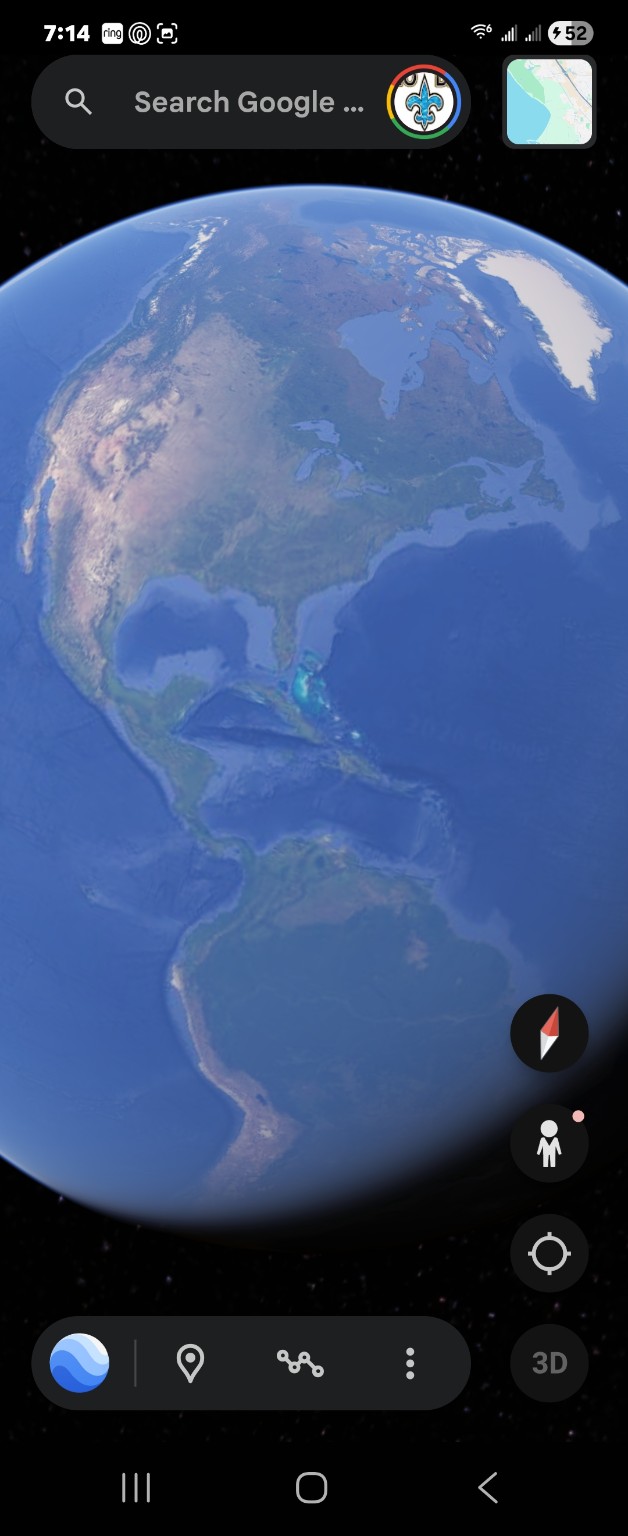
The May source screenshot is shown separately because its framing differs from the November registration pair. It is not used beneath the November artwork.
Explore the chain-holders
Kratos: the North American Chain-Holder · South American Chain-Holder
These companion dossiers distinguish Brett’s adopted northern name from the tentative southern literary comparison. Image review is pending.